
Article: How to Care for Your Sheets in Winter
How to Care for Your Sheets in Winter
Good sheet care matters all year round but winter changes things a bit - less sun, slower drying, more time in the dryer - all of which create more opportunity to damage fabric if you're not paying attention. Here are our tips on sheet care through the colder months.
Tumble drying
Tumble drying is harder on cotton than line drying, and that's always true - but in winter it's often the only practical option. The things to watch are heat and time.
Use low heat. High heat degrades cotton fibres, causes shrinkage, and is the single biggest controllable factor in how long a sheet lasts. Low heat takes longer but is significantly kinder to the fabric - this is especially important in winter when it’s often your only option.
Remove while still slightly damp. Cotton that comes out of the dryer completely dry has been in there too long. Pull the sheets out while there's still a little moisture in them and either hang them to finish drying or make the bed immediately - the residual warmth and smoothing out by hand will help them settle without creasing badly.
Don't overload the drum. Sheets need room to move. A drum packed too tight restricts airflow, increases drying time, and means the sheets spend longer tumbling than they need to - all harder on the fabric.
Wool dryer balls are worth using if you have them. Testing consistently shows they reduce drying time by roughly 10–25% by separating the fabric and improving airflow - which means less time in the drum overall. They won't dramatically change the result, but shorter drying time with better airflow is a genuine benefit for fabric longevity. They also help to reduce static.
Air drying in winter
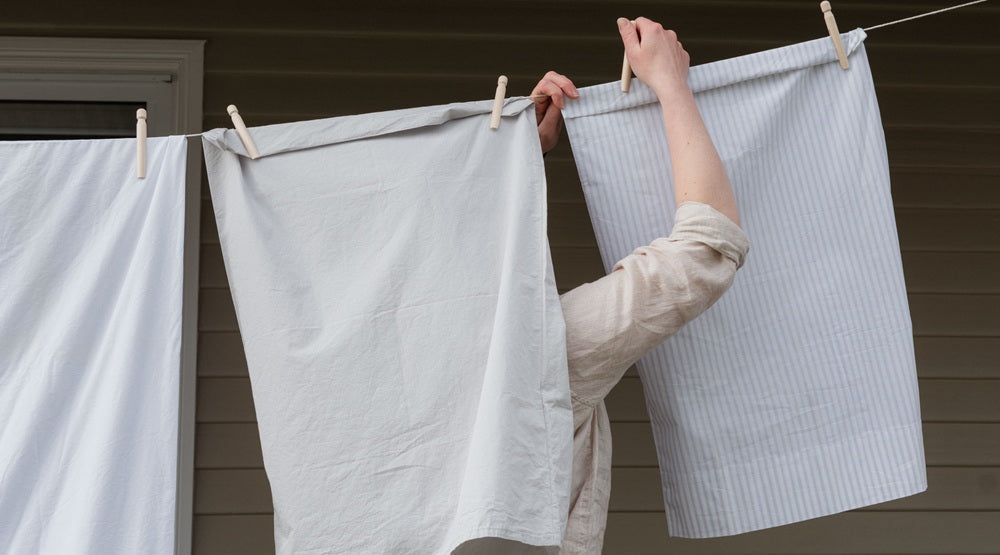
Line drying in winter is slower but not a problem if you have the space and are willing to wait longer.
Hang sheets in a spot with reasonable airflow rather than a still, enclosed space. A garage with no ventilation or a bathroom with the door closed will leave sheets sitting damp for hours, which encourages mildew and that familiar musty smell that's hard to shift.
Outside is fine on a dry winter day even without direct sun - UV is weaker in winter but airflow does most of the drying work anyway. Just don't leave them out overnight or through rain. Sheets left hanging for days in cold, damp conditions are not airing - they’re marinating in the perfect conditions for mould and mildew.
If drying inside, a heated room with a window cracked open is better than a cold, still one. A clothes rack positioned to get some airflow rather than tucked in a corner will dry significantly faster.
Storing sheets over winter
If you're rotating sets or putting a spare set away for an extended period, storage matters.
Avoid plastic. Plastic bags and sealed containers trap moisture, restrict airflow, and are the fastest route to musty, yellowed sheets. Cotton or linen storage bags are the better option - they breathe, keep dust out, and won't create a microclimate inside.
Store dry. Sheets that go into storage with any residual moisture will come out smelling musty at best, mouldy at worst. Make sure they're completely dry before folding and putting away.
Cool, dark, and dry. A linen cupboard is ideal. Avoid storing sheets in spaces prone to humidity - bathrooms with poor ventilation, garages, attics, or anywhere that gets damp in winter. Moisture is the enemy of stored cotton.
Don't pack too tight. Sheets compressed hard against each other for months will develop creases that are difficult to remove, and restricted airflow increases the risk of mustiness. Leave a little space.
A useful trick: fold your sheet set and store it inside one of its own pillowcases. A pillowcase keeps it all together and lets the fabric breathe.
Too long, didn’t read?
If there’s one takeaway from this - don't overdry. More damage happens in the dryer than anywhere else in the laundry process - heat degrades fibre, time in the drum causes friction and wear, and over-dried cotton becomes brittle faster than cotton that's been treated with a little care. Low heat, out while still slightly damp, and you’re 90% of the way there.
Shop our Heavyweight Percale Bedding.